Thursday, 29 December 2011

Leaving Cambridge...

Living in at Gonville and Caius and getting a taste of student life at Cambridge was an amazing experience. It allowed me to meet very special people, including my resident tutors, and to be taught by a number of inspiring lecturers and leaders. It also vastly expanded my knowledge on a number of topics from viewpoints that I would not have considered otherwise. 


Whilst my own course, 'International Politics in a Global Age' covered a range of fascinating topics, there was also a set of plenary lectures around the theme of 'understanding'. My politics lectures varied largely, including 'female education in China and Africa', 'nuclear proliferation and climate change', 'the European Union financial meltdown', 'Humanitarian War' and also very current topics such as 'the Arab spring', 'Russia', 'the rise of China in Africa' and the debatable meaning of 'democracy'.  

In contrast, the morning and evening plenary lectures covered a much wider range of topics, these included 'understanding...;' 'British Secret Intelligence'; 'evolution'; linguistics; 'the Cold war'; 'building bombs' and many more fascinating topics. 

In order to understand 'Understanding', we were shown an image by Hanabusa Itcho (1652–1724) called "Blind monks examining an elephant", this is based on a parable which can be seen throughout many religious traditions and is part of Jain, Buddhist, Sufi and Hindu lore.


The story is generally about a group of blind men who touch an elephant to learn what it is like. Each man feels a different part of the elephant, such as the trunk, ear or tail. They then compare what they have felt and completely disagree with one another. This story varies in regards to how violent the conflict then becomes and whether it is resolved. However, according to the Buddhist story, the King and the Buddha are consulted. Here, the story ends with the Buddha comparing the blind men to preachers and scholars, who's realities are different but may only preach one single viewpoint, to the point of conflict.

I found this an amazing story against ignorance and intolerance. Whilst each party (in either the parable, or in the wider world of politics) may wholeheartedly believe in their 'truth', they may still be ignorant of another party or person's beliefs or 'truth'. 

Whilst I was in Cambridge, I was lucky enough to also see an open aired Shakespeare play (even though it rained!) in King's college garden. I watched a string quartet performance and I also managed to attend three formal dinners, including my leaving dinner, where I received my graduating certificate.


Tuesday, 26 July 2011

Global Warming

Here are two interesting images that I came across during my global warming lectures; a pollution map and a flag map!


Bipolar World

Thursday 14th July, 2011

Kagan, R. (2003) Paradise and Power – America and Europe in the New World order. 

For my first class in ‘International Politics in a Global Age’ Dr. Philip Towle taught us. The subject for this class was ‘The new world order in 1945 and 1991’ and ‘The bipolar world’. Dr. Towle is the longest serving member of staff at the Cambridge Centre for International Relations. He has previously worked for Reuters and the Foreign and Commonwealth Office. He is extremely British!

One of the books on our reading list was ‘Paradise and Power – America and Europe in the New World order’.  I found some of the ideas in this book very interesting.

This book explains that the UN Security Council was designed by the United States to give the five “great powers” of the post war era sole authority to decide what was and was not legitimate action in the international arena.

At the time that this book was written, the Security Council contained only one “great power”, the United States. Today, China is obviously also a great power, however this book was discussing the current cynical view in American strategic circles that the Europeans have simply enjoyed the “free ride” they have gotten under the American security umbrella over the past six decades.

The book also goes on the claim that Europeans today have moved away from their ambition for power, particularly military power, which they obviously had in their colonial days, but goes on to say that over the past half-century, Europeans have developed a different perspective on the role of power in international relations, (a perspective that springs directly from their unique historical experience since the end of WW1). Kagan claims that they have rejected the power politics that have brought them so much misery over the past century and more, and that this is a perspective that Americans do not and cannot share…
…This book also argues that Europeans speak with great confidence of the superiority of their global understanding, (as Americans have for two centuries) of the wisdom they have to offer other nations about conflict resolution. An interesting argument within the book can be seen through this tongue in cheek quote:

 Given America’s willingness to spend so much money protecting them, Europeans would rather spend their own money on social welfare programs, long vacations and shorter workweeks.

The whole book generally highlights that America's preeminent global position has thrust it into a dangerous world of terrorist threats and made it more willing to use force, whereas Europe seeks peace through law and diplomacy. It uses an insightful metaphor: If you have a hammer, you are more likely to see every threat as a nail.

There is also another quote that I found interesting about the current world order, which suggests that life is not so fun at the top.

“Americans are “cowboys” Europeans love to say. And there is truth in this. The United States does act as an international sheriff, self-appointed perhaps but widely welcomed nevertheless, trying to enforce some peace and justice in what Americans see as a lawless world where outlaws need to be deterred or destroyed, often though the muzzle of a gun. Europe, by this Wild West analogy, is more like the saloonkeeper. Outlaws shoot sheriffs, not saloonkeepers. In fact, from the saloonkeeper’s point of view, the sheriff trying to impose order by force can sometimes be more threatening than the outlaws, who, at least for the time being, may just want a drink.”

Tuesday, 12 July 2011

The Structure of my Days


 Tuesday 12 July, 2011

The Structure of my Days

From 7.45am: Breakfast in Gonville and Caius Dining Room

9.00 – 10.15am: International Politics in a Global Age (A01)

10.30 – 11.30am: Plenary Lectures. (The theme this year is UNDERSTANDING. So there is going to be lectures varying from Understanding Language; Russia; Macbeth,  the Plague! As well as many others!)

11.45-1.00pm: International Politics in a Global Age (B01)

Lunch

2.00 – 3.15pm: International Politics in a Global Age (C01)

6.30pm: – Dinner in the Gonville and Caius Dining Room

8.00 – 9.00pm: Evening Plenary Lecture


 For the next 4 weeks…! :) 

CAMBRIDGE!

Monday 11 July 2011 

CAMBRIDGE!
 
Today I started the international summer school at Cambridge University. My trip down here from Manchester was not too bad and luckily, when I had to change stations, the platform attendant helped me carry my two cases and made the train wait for me, which was great, otherwise I would have missed the train!

When I first arrived at Gonville and Caius, I got acquainted with the porters, at the porters lodge who gave me my initial information, my keys and passes to get in and out of everywhere as well as a student card. He told me to put it around my neck immediately so as to not lose it, which amused me.

I went over to St. Mikes, which is across a quaint little road named Rose Crescent and climbed a spiral stone staircase. Two builders carried my cases, which was so kind as it would have taken me an age otherwise! When I got to the top, I couldn’t figure out the code for the door, so the cleaner let me in and showed me how to do it, we ended up chatting for ages, which was lovely. She showed me up to my room and informed me that I was so lucky because I had the only en-suite in the whole building!

My room is on the third floor and when you first open the door, there is a lounge area with what must have been a big fireplace, but is now a radiator! There is a bathroom with a toilet and a shower beyond the lounge as well as two bedrooms. One overlooks Gonville and Caius’ Courtyard and the other overlooks the high street. I chose the latter. Whilst I was unpacking, the cleaners knocked on my door to have another chat and a bit of a nosy to see if anyone else was in the other room yet. They showed me where I could hang things up because there was no wardrobe in my bedroom and said they would bring me any hangers if there were any left in the other rooms!

About half an hour later, my new room mate arrived; Andrew. He is from South Carolina and is doing the Literature Summer Course. He is focusing on Elizabithan love poetry and ‘Off with their heads’ which is a course that spans literature from Shakespeare to Alice in Wonderland, which sounds wonderful.

After we had both unpacked and realized that we could “borrow” Internet from a café over the road, we both walked to the registration site, which was over in ‘Lady Mitchell Hall’. On the way, we passed the newer Gonville and Caius halls,  which was named after  Steven Hawking, as he is also a Fellow of Gonville and Caius College, it also contains his office! So we might even see him around!
 
After registration,  Andrew and I returned to our college, which involves a 15 minute walk through either Kings College, which is stunning or St. Clares which is equally beautiful. Both involve crossing the river, so you get to see the punts, which reminds me of Oxford. However they punt stood in a different place on the boat over here!

(A punt is a flat-bottomed boat, Punting refers to boating in a punt. The punter generally propels the punt by pushing against the river-bed with a pole. A punt should not be confused with a gondola, which is propelled by an oar rather than a pole.) 


At 6.30pm we had our first dinner in the Gonville and Caius Dining Hall. There are three long wooden tables and beautiful portraits of academics on the wall. There is also one of the academic celebrity Steven Hawking – however there are NO women! We were served a three course meal here by a completely Spanish crew of serving staff. When one of the waitresses dropped something, she cursed in Spanish and a number of students around the table either laughed or frowned, but now I know the people who speak Spanish, which is great! 


At dinner, we also met one of our live in tutor/student reps. These are current undergraduate students at the university who live inside the colleges during the summer schools to help organize everything and help students.

After dinner, we all went back to Lady Mitchell Hall, which is on the Sedgewick site and had our ‘Welcome and Practical Orientation Session’. The summer schools at Cambridge have been taking place since 1923 and this year, there are more than 34 nationalities represented! We were told that we should aim to meet the other 33 before we leave! I look forward to it!

Monday, 9 May 2011

!Lunes De Agua!

Lunes de Agua (literally: “Water Monday”) is a festival held every year on Monday after Easter. After the traditionally strict 40 days of Cuaresma (Lent) and Semana Santa (Easter Holy Week),  Lunes de Agua is a chance for citizens to celebrate the end of their sacrifice for lent.

The origins of Lunes de Agua date back to the 16th century. Along with the prestigious university, Salamanca also had prostitutes who hoping to eventually make it to the royal courts, practiced (so to speak) with the university students. Back in the 16th century, King Felipe II, who was known as a very serious and devout Catholic, was disgusted with the marginal activities taking place in Spain’s prominent academic hub, therefore ordered the prostitutes be banished from the city during the 40-day abstinence period of Lent, so that the men of Salamanca, could avoid the temptations of the sin of lust. From Ash Wednesday, the prostitutes were taken to Arrabal the bridge across the River Tormes. 

For 40 days, the girls would be confined to live on the other side of the river until Lunes de Aguas – the day they could return to the city. Citizens would gather to watch how the students set up huge welcoming parties by the riverbanks for the prostitutes, and enthusiastically assist the priest (who was in charge of the girls’ welfare during their exile) in crossing them over the river on flower-decorated boats. The rest of the day would be spent eating, drinking, and celebrating by the river, whose waters gave name to the event. Only the last part of the celebration, however, is the one that continues as tradition today.

Nowadays, friends and family meet at the riverbanks of Salamanca’s Río Tormes and any open space such as public parks or countryside to share what is essentially a huge picnic. It is a time when ‘Salmantinos’ relax, have fun, and eat the typical hornazo - a non sweet pastry pie filled with ham, sausage, bacon, cooked egg, and sometimes even chicken – which is sold in shops all over the city. Obviously I didn’t eat one of these, because I don’t eat meat, but one of our friends called Von Travis had one that his host family Mom made and said it was good! Most businesses also voluntarily close for the day in order to partake in this festivity. They appear to take any chance to shut up shop for the day in Spain.

After class, most of my friends and I went to the river for a picnic. There were so many people. It was a fun day! 


Saturday, 7 May 2011

Semana Santa

Semana Santa in Spain is the Christian tradition of Holy week. It is the last week of Lent and the week before Easter and it includes the religious holidays of Palm Sunday, Holy Thursday and Good Friday. It lasts from Palm Sunday until, but not including, Easter Sunday.  

My friend Kathryn came to visit me in Salamanca during Semana Santa, which had its upsides and downsides. Unfortunately for Kat, the weather in Spain was really miserable during Semana Santa and because it is a religious holiday, all the shops were closed. However, we did get to be tourists for the weekend and see  churches, some of the impressive processions held in Salamanca and of course the nightlife.

On Kats first day in Salamanca, we went to visit the big Cathedral in Salamanca called ‘Old Cathedral’. The architecture in Salamanca is bonita – beautiful!


Afterwards we had lunch nearby and I ordered in Spanish! I always find the culture when learning a language really interesting. It is not considered at all rude or ‘mal education’ when shouting a waiter over using ‘Oiga!’ (Listen).

 
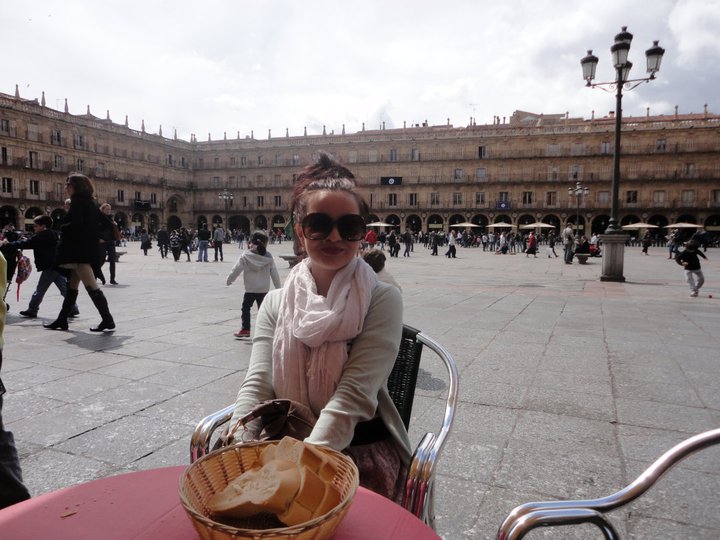
We also had a coffee in Plaza Mejor and Kat tried to take ‘fotos’ in order to create a panoramic image – I have done my best! During the weekend, there was a book fair at Plaza Mejor also, to celebrate international book week,


We also saw plaza mejor at night, when it is all lit up.  Kat and I had a good night with all my friends from my accommodation ‘Pinzones’ and Kat took a picture “for the fridge” of everyone who lives in my flat.


We were also lucky enough to see some of the Semana Santa processions, the worshippers  here carry "pasos", lifelike wood or plaster sculptures of individual scenes of the events that happened between Jesus' arrest and his burial. They are carried through the streets by penitents dressed in long purple robes, often with pointed hats, followed by women in black carrying candles. These pasos are physically carried on the necks of costaleros (literally "sack men", because of the costal, a sack-like cloth that they wear over their neck, to soften the burden) as they can weigh up to five metric tonnes.


A common feature in Spain is the almost general usage of the nazareno or penitential robe for some of the participants in the processions. This garment consists in a tunic, a hood with conical tip (capirote) used to conceal the face of the wearer, and sometimes a cloak. The robes were widely used in the medieval period for penitents, who could demonstrate their penance while still masking their identity. (These robes majorly resemble the KKK and were apparently intentionally served as the basis for the uniform for members of the Ku Klux Klan in the United States; ironically a very anti-Catholic organization.) 


A brass band, marching band, a drum and bugle band accompany the group, playing funeral marches, religious hymns or "marchas" written for the occasion.


On Easter Sunday, events come to a head in Salamanca's stunning Plaza Mayor, with a reenactment of the resurrection from midday, along with much singing and dancing. We also saw an amazing brass band playing here.


Saturday, 30 April 2011

My Graduation and Weekend in England


I finally had my graduation ceremony in Oxford! I flew back from Spain to get there and my parents travelled from opposite ends of England, but it was (despite being a bit stressful!) one of the best days of my life! I felt very proud to graduate with a FIRST CLASS HONORS DEGREE!! All the hard work paid off! It was also so good to see my family. (Photographs taken by the amazing Stuart Weston - www.stuartweston.com). We all went for a meal together after the ceremony in the Quod and could finally catch up properly, rather than over skype!


After my graduation, I spent a few days between Oxford and London, where I managed to catch up with my good friend Kathryn. We went to Broadway market together, along with her housemate Ellie, where I bought a vintage bottle of balsamic vinegar! I soon realized however that as this was more than 100ml, I would not be able to take it back to Spain, because I only had hand luggage with me. Kat however saved the day, by promising to bring it when she came and visited me in Salamanca the week after!


After Broadway market, we went to a lovely little Italian restaurant, where there was even a funny Italian playing the accordion!


A fun weekend in Inglaterra! xx

Sunday, 24 April 2011

Mi Vida en Salamanca

My first few weeks in Spain have been really fun. It has been interesting getting to know all the different international students – although everyone in my house, which is called ‘Pinzones’ speaks English, which is not too ideal for practicing Spanish! However it is probably one of the most fun places to live in Salamanca, it reminds me of being back in halls at university!

My accommodation is split into 5 floors with 6 bedrooms on each floor. The university either organizes it, or people can choose to rent here by themselves. One of the first nights I was here, we all had a sushi night on the third floor!


Other days, after class, which for me is 9am - midday, we sometimes go to the park to sunbathe and have picnics (when the weather permits!) One of our Japanese friends Yasu has a fisheye camera – hope he doesn’t mind me borrowing some photos for my blog! xx


After working at parliament, completing my finals and working in an investment bank in Shanghai, in such a short period of space, this was a really good chance to finally wind down and relax a little!  University is also going quite well up to now, I feel like I am learning lots, although once I finally settle in properly, I will definitely step up the pace of self study, I think I must be having withdrawal symptoms!

Tuesday, 5 April 2011

España


So I am finally in Spain! My journey here however was horrendous! I was obviously really tired after arriving in Manchester, unpacking, repacking and visiting family. However, I did get to spend time with my amazing Madre on Mothers day, which was perfecto. My flight to Spain was peaceful, there were mainly Spanish people on the plane and everyone clapped when we landed, which I thought was nice. 

I arrived into Madrid airport in my floor length maxi dress, sunglasses and mini denim jacket to be greeted by torrential rain. I was pretty mortified to say the least. I had to ask in my very unpracticed Spanish where to find the autobus to Salamanca. I was directed to the coach-parking bay where I had to trek through puddles – in the rain with two suitcases and two large bags. Luckily there was a coach to Salamanca already there, relieved I started loading my cases into it, when the driver informed me it was a school bus and I was not on the list. I waited in the rain for about half an hour, soaked to the bone. Not ideal.

When no bus arrived, I decided to get a taxi to the train station, so that I could get the ‘tren rapido’ to Salamanca. I now know that the taxi driver ripped me off to quite a large degree as he charged me double what it should have cost. Nice. I even thought he was so lovely because he gave me 2 Spanish magazines to read on the train. They were called ‘QMD’ which looked to me like ‘OMG’ but actually means ‘Que me dices’. 

When I arrived at Madrid train station, I was told that I would have to take the metro to a different station called Chamartin in order to get to Salamanca. I was sold a ticket to Salamanca but was told I would have to use the automated ticket machine in order to buy a subway ticket. It took me around half an hour to find this machine. Luckily a Spanish gent helped me to use it, as I was getting rather tired and stressed by this point. He proceeded to ask me for my number though, which was not cool. 

After this, I fell down an escalator. Whilst struggling with my 2 cases, my laptop bag and my handbag, my wet maxi dress got caught and I literally toppled over. I nearly broke my neck. Some Spanish nuns helped me up. I was literally near to tears! I thought things could not get much worse.

I somehow managed to get myself on the train to Salamanca. Of course, it was no rapido tren, it was the slow one, which took 2 hours. My programme coordinator Rafa had his phone off and my battery was going on my phone. I also had forgot to write down my Spanish address with all my traveling and only had it on email. There was no wifi on the train and I was beginning to panic. Luckily, there were some plugs on the train so I charged my dying blackberry and could read my emails to get the address. 

After waiting in a queue outside Salamanca train station for around 20 minutes, I finally got a taxi to my new apartment and got through to my landlady who called my programme coordinator. Although I had to wait 15 minutes to get into the building, I finally did! The apartment is lovely, although when I first arrived there was no bedding at all and it was so cold. There was a big party on the floor below me also and I was exhausted. 

Thankfully, my new lovely housemates came home at around 3am and gave me some quilts and bedding, so I finally got to sleep, enough time for my brain to readjust to Spanish, in order to take my Spanish proficiency test at 9am the next morning!

Here are some photos of my new apartamento!